Gallery
The Legitimacy Signal Model (LSM)
The Legitimacy Signal Model (LSM)
Core Claim:
The central claim of the Legitimacy Signal Model is that authority can persist, stabilise, and expand without being constrained by legitimacy, provided legitimacy continues to function as a signal rather than a boundary.
This condition does not require deception, bad faith, or the abandonment of ethical discourse. It emerges structurally when legitimacy becomes decoupled from veto power and reconfigured as an informational or performative output.
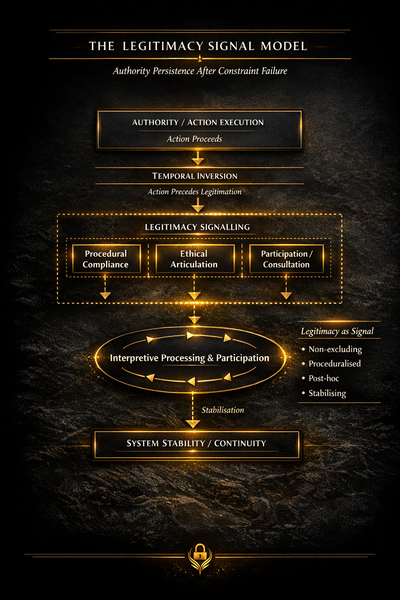
The Legitimacy Signal Model (LSM)
The Legitimacy Signal Model (LSM) describes a structural condition in which legitimacy no longer functions as a constraint on authority, but persists as a signalling system that stabilises power, absorbs dissent, and enables continuity without veto.
Under the LSM, legitimacy does not determine what actions may or may not occur. Instead, it operates as an indicator of procedural compliance, ethical articulation, or participatory inclusion, without possessing the capacity to halt, reverse, or meaningfully revise outcomes.
Legitimacy remains visible, articulated, and institutionally embedded, but it no longer governs.