Gallery
Governance Transformation Architecture
Governance Transformation Architecture
Core Claim:
Governance systems are not static arrangements.
They operate within a constrained admissibility landscape and transform through structurally defined modes.
They operate within a constrained admissibility landscape and transform through structurally defined modes.
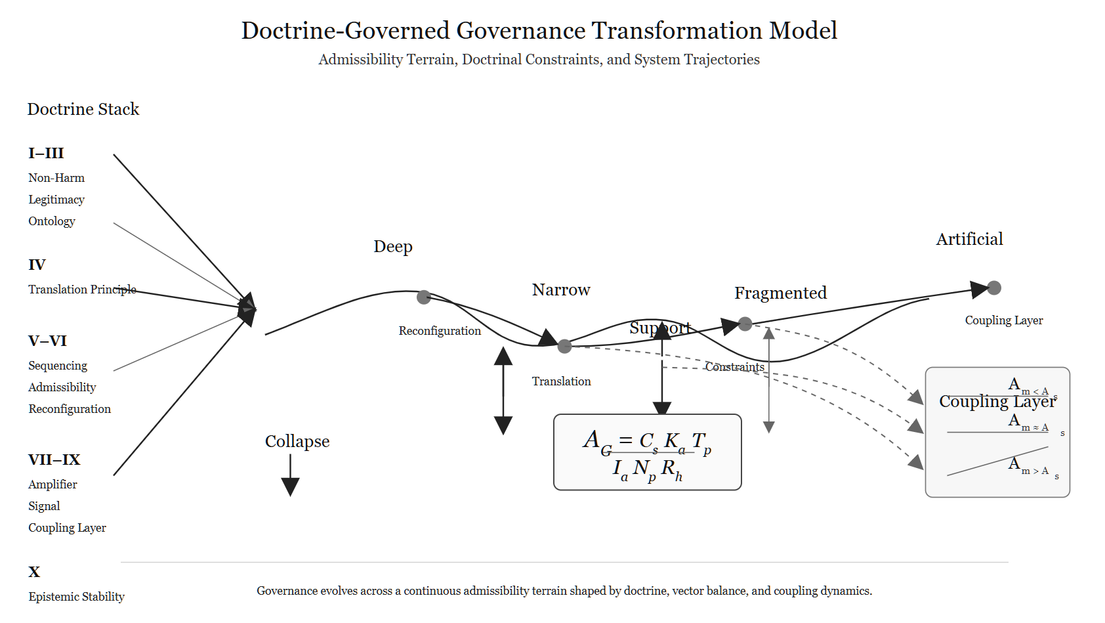
Structural Architecture
The model consists of three integrated components:
Doctrine Stack (I–X)
A vertical constraint system defining:
- admissibility limits
- sequencing requirements
- and conditions of epistemic stability
Admissibility Basin
A continuous structural field in which governance systems operate.
- Deep basin → stable governance
- Narrow basin → mediation
- Fragmented basin → competition
- Artificial basin → capture
The basin is shaped by the balance between:
- enabling conditions
- and destabilising pressures
Transformation Trajectories
Governance systems move across the terrain through distinct structural states:
- Reconfiguration
- Collapse
- Competition
- Mediation
- Capture
These are not stages, but possible configurations of system behaviour.
The Governance Transformation Model
The Doctrine-Governed Governance Transformation Model (DG-GTM) presents governance as a threshold-bound system operating within an evolving admissibility terrain.
The model integrates:
- doctrinal constraints
- structural admissibility
- basin dynamics
- and system trajectories
into a single analytical architecture.
Publications
The model is formally developed in:
- Doctrine-Governed Governance Transformation: A General Theory of Admissibility and System Evolution
- Post-Semiotic Governance
- Sequencing Meaning and Power
Interpretive Position
The model establishes that governance is governed by:
- admissibility thresholds
- structural constraints
- and dynamic transformation under pressure
Stability is not guaranteed by design.
It depends on whether systems remain within admissible regions of the governance terrain.
Coupling Condition
The model identifies a critical structural variable:
the relationship between narrative systems and structural reality.
- Coupled systems → stability
- Decoupled systems → instability
- Capture systems → narrative dominance
Analytical Function
The Governance Transformation Model is a diagnostic system.
It enables:
- identification of admissibility conditions
- classification of governance states
- analysis of system stability
- evaluation of transformation trajectories
Position Within the Research Architecture
The model operates as the integrative framework of the Philosophical Intelligence system.
It connects:
- PIE — interpretive discipline
- IOM — structural classification
- LSM — legitimacy dynamics
- PSO — sequencing logic
- PSG — post-semiotic conditions
Clarification
This model does not prescribe policy or advocate positions.
It defines:
the structural conditions under which governance systems remain viable, transform, or fail.