Gallery
Framework Architecture
Framework Architecture
Core Claim:
The central claim of the Framework Architecture is that disciplined interpretation requires structured layering and threshold control.
Meaning, inner transformation, admissibility, issue configuration, legitimacy designation, and governance classification are not isolated domains. They operate within an integrated analytical system governed by evidential thresholds, responsibility anchoring, and structural discipline.
The architecture clarifies how interpretation escalates, how claims become admissible, and how classification becomes warranted. It also establishes the conditions under which escalation must be refused.
Without this structure, interpretive inflation occurs: signals are misread as structures, and provisional narratives are treated as reality. With it, analytical restraint is preserved and governance classification remains accountable.
Each framework occupies a distinct analytic domain. Together, they form a coherent methodological system for managing complexity, maintaining epistemic stability, and enabling responsible structural designation.

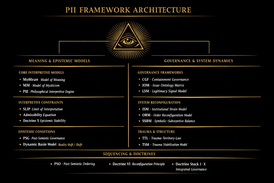
The architecture demonstrates that interpretation must proceed through a disciplined sequence:
Meaning → Interpretation → Admissibility → Issue Configuration → Legitimacy Designation → Governance Classification.
The Philosophical Interpretive Engine (PIE) governs this sequence, enforcing constraint before escalation. The Admissibility layer—formalised through SLIP and the Admissibility Equation—ensures that structural claims are only made where evidential density, responsibility anchoring, and durability thresholds are met.
Without this discipline, interpretive inflation occurs: signals are mistaken for structures, and narratives for reality. With it, classification becomes both precise and accountable.
At higher thresholds, Post-Semiotic Governance (PSG) marks the point where signification alone can no longer stabilise systems, requiring structural intervention. The Doctrine layer (including Reconfiguration Principle and Epistemic Stability Principle) governs system behaviour under stress, transition, and epistemic instability.
The Framework Architecture is therefore not a collection of independent models.
It is an integrated system of analytic restraint, sequencing, and structural designation—designed to maintain coherence under conditions of complexity, pressure, and change.
It is an integrated system of analytic restraint, sequencing, and structural designation—designed to maintain coherence under conditions of complexity, pressure, and change.
Framework Architecture
The Framework Architecture visualises the integrated system of models governing meaning, interpretation, and institutional order:
Philosophical Interpretive Engine (PIE) — methodological core for interpretive constraint and admissibility
Model of Meaning (MoMean) — structural formation and stability of meaning
Model of Mysticism (MM) — transformation within inner interpretive fields
Issue Ontology Matrix (IOM) — classification and sequencing of issue types
Containment Governance Framework (CGF) — governance under constraint and capacity limits
Legitimacy Signal Model (LSM) — distinction between legitimacy and signalling structures
Institutional Strain Model (ISM) & Order Reconfiguration Model (ORM) — system stress and reorganisation dynamics
Model of Meaning (MoMean) — structural formation and stability of meaning
Model of Mysticism (MM) — transformation within inner interpretive fields
Issue Ontology Matrix (IOM) — classification and sequencing of issue types
Containment Governance Framework (CGF) — governance under constraint and capacity limits
Legitimacy Signal Model (LSM) — distinction between legitimacy and signalling structures
Institutional Strain Model (ISM) & Order Reconfiguration Model (ORM) — system stress and reorganisation dynamics
Post-Semiotic Governance (PSG) — threshold where signification loses governance function
Trauma–Territory–Law (TTL) & Trauma Stabilisation Model (TSM) — trauma as structuring force of order
Trauma–Territory–Law (TTL) & Trauma Stabilisation Model (TSM) — trauma as structuring force of order