
Back Office
Villa Intellia | Private Consulting in Project Management Documents
Project Management Documents
What Is Project Documentation? The term project documentation refers to the project management documents that are created throughout the project life cycle. These documents, such as the project plan, project schedule or project budget, define activities, procedures and guidelines that the project team should follow.
Project documents may influence quality assurance work and should be monitored within the context of a system for project configuration management. Project documents may include, but are not limited to, agreement, quality audit reports and change logs supported with corrective action plans. Training plans and assessments of effectiveness, and process documentation such as quality tools and quality management and control tools.
Project documents provide the project team with information about decisions that hep better identify project risks. Project documents improve cross-team and stakeholder communications and include, but are not limited to: project charter, project schedule, schedule network diagrams, issue log, quality checklist, and other information proven to be valuable to identify risks. Risk-related contract decisions need to be included as documentation within the risk register.
Multiple project documents originating from initiation, planning, execution, or control processes may be used as supporting inputs for controlling stakeholder engagement. These include, but are not limited to: project schedule, stakeholder register, issue log, and project communications.
The project management plan and the project documents are managed separately. Though these are used to manage the project, we need to distinguish between them as one being the management plan, and the other being the related documentation of the project.
For project documents management, information management systems can be used as a standard tool for the project manager to capture, store, and distribute information to stakeholders about the project cost, schedule progress, and performance. It also allows the project manager to consolidate reports from several systems and facilitate report distribution to the project stakeholders.
Examples of project documents management using information management systems in terms of distribution formats include: log entries, account transaction entries, calendar entries, schedules, documents, reports, all project correspondences, table reporting, spreadsheet analysis, presentations, digital charts and graphs, digital multimedia, digital operational data capture, data-entry and data exchange across distributed strategic data management architectures.
Before you start to think that the planning sounds like a huge amount of electronic ‘paperwork’ remember that some of the plans may be quite short and simple, though still necessary. However, you always need to be careful to only produce what you really need to control the project. Clearly a small, simple, low-risk project will need much less in terms of planning and control than a large, high-risk and business critical one. The documentation should reflect those different control needs, and in particular the control needs for your project specifically.
Project Management Plan
The Project Management Plan
The project management plan may be either summary level or detailed, and may be composed of one or more subsidiary plans. Each of the subsidiary plans is detailed to the extent required by the specific project.
Please note that once the project management plan is baselined, it may only be changed when a change request is generated and approved through the perform integrated change control process.
The perform integrated change control process is the process of reviewing all change requests; approving changes and managing changes to deliverables, organizational process assets, project documents, and the project management plan; and communicating their disposition. It reviews all requests for changes or modifications to project documents, deliverables, baselines, or the project management plan and approves or rejects the changes. The process is conducted by convening meetings, inviting and soliciting for expert judgements, stakeholder consultations, considering customers and considering suppliers, summoning the individuals and person that is responsible, communication with the project sponsor, and of course communicating with the project manager.
The perform integrated change control process is the process of reviewing all change requests; approving changes and managing changes to deliverables, organizational process assets, project documents, and the project management plan; and communicating their disposition. It reviews all requests for changes or modifications to project documents, deliverables, baselines, or the project management plan and approves or rejects the changes. The process is conducted by convening meetings, inviting and soliciting for expert judgements, stakeholder consultations, considering customers and considering suppliers, summoning the individuals and person that is responsible, communication with the project sponsor, and of course communicating with the project manager.
The Components of the Project Management Plan
- Change Management Plan
- Communications Management Plan
- Configurations Management Plan
- Cost Baseline
- Cost Management Plan
- Human Resource Management Plan
- Process Improvement Plan
- Procurement Management Plan
- Scope Baseline
- Project Scope Statement
- Work Breakdown Structure (WBS)
- WBS Dictonary
- Quality Management Plan
- Risk Management Plan
- Schedule Baseline
- Schedule Management Plan
- Stakeholder Management Plan
The Project Documents
How many documents attend the project operation and are selected and used by the project manager can range from none to hardly any, to a simple or basic tools, to using a more comprehensive range of documents and tools, and using the documents and tools that are deemed essential for a normal business standard. In addition to that, to use those documents and tools as have been outlined by professional standards. And there is the option of using the professional international standard that is globally recognized.
The list of essential project documents that are considered the standard project documents in business:
- Project Business Case
- Project Plan
- Project Charter
- Project Status Report
- Project Communications Plan
- Work Breakdown Structure (WBS)
- Project Budget
- Statement of Work
- RACI matrix
- Change Requests Management
- Risks Log
- The Action and Issues Log
- Lessons Learned
- Project Closure and Formal Sign-off
Project Management and Operations Management
Project management at the conceptual level is a discipline that fundamentally can rest on its own concepts and in its own dimension. Project management as practised in the logical relationships and physical relationships, is the consideration of operations management.
How the operations of the organization and the project are performed is practically and usefully managed and described in the normative terms and normative practices of business mathematics. Business mathematics is a major part of the language and vocabulary of project management.
Project documentation must include the numbers, charts, graphs, mathematical functions, mathematical equations, quantitative business methods, network computations, and the data that is used in these computations and calculations to maintain the proper standard documentation that forms the body of the project documentation and project management documentation.
Quantitative Business Methods
Applied Mathematics: Quantitative Business Methods
Project management must ensure that the project manager, and any person responsible, has the relevant understanding, proficiency and expertise in the purpose and use of quantitative business methods, operational mathematics and financial mathematics of the business managed. Project management documentations include facts, numbers, charts, graphs and calculations.
Project management documentations must include the clearly defined, clearly captured and interpreted data of accounting for all monetary, time relationship, schedule, calendar, contract, staff, service, resource, cost, benefit, returns and projections, including the actual figures and the figures in theoretical financial mathematical simulation.
The project management report has to clearly define, display and express, the operational mathematical and financial mathematical, information of the project in the language of the business genre and generation.

The Project Management Documents of PMBOK 6th edition 2013
Project Management Institute | International Global Standard | 33 Project Documents.
Standard Project Documentation
The Project Management Body of Knowledge (PMBOK)
For more than fourty-five years, the Project Management Body of Knowledge (PMBOK) has been a leading tool in the project management profession and is an essential reference for the library of every project manager. Today the PMBOK is recognized as the global standard for project management is one of the best and most versatile resources available for the professional. This internationally recognized standard gives project managers the essential tools to practice project management and deliver organizational results.
In the table with the blue-heading on the left side of the page, are tabled all the title names of the project management documents that have been outlined and detailed by the PMBOK international standard.
In the following section and paragraphs below, you can read the description for the standard titles found in the blue-headed interactive table on the left of the page. This will provide you with a more detailed understanding and essential comprehension of project management documents and the the project management plan.
Standard Reference Documents (ISO endorsed)
Project Integration Management
- Project Charter (PMBOK 4.1.3.1). This document initiates the project and authorizes the project manager. It documents the business need for the project as well as assumptions and constraints the project must live under. It generally includes high level scope and quality information. It is issued by the project sponsor and represents the organizational authorization for the project.
- Project Management Plan (PMBOK 4.2.3.1). This is the project managers road map and guiding document. It is probably the single most important document for the project manager. It outlines how the project will be managed, and includes the project schedule, budget, quality standards, project team requirements, project control, and anything else that is necessary to communicate how the project will be managed. It should be approved by the project sponsor and changes made according to the official change control procedures specified within.
- Change Requests (PMBOK 4.3.3.3). When a stakeholder wishes that the project manager make changes to the project, a change request form is filled out and filed within the project management plan.
- Work Performance Reports (PMBOK 4.4.3.2). In order to communicate the project performance to the relevant stakeholders, the project manager or their delegate produces regular performance reports. These include earned value reports, memos, justifications, recommendations and the like.
- Change Log (PMBOK 4.5.3.2). The project management plan contains a record of all changes made, to ensure that the project is tracked and lessons learned are gleaned from the changes.
Project Scope Management
- Scope Management Plan (PMBOK 5.1.3.1). A component of the project management plan, this document outlines how the project scope will be managed, how scope changes will be addressed, and how the project scope will be monitored and controlled to ensure scope changes do not happen unless they are required.
- Scope Statement (PMBOK 5.3.3.1). This is the official statement which outlines the scope of the project. It should outline the primary project deliverables as well as expressly include or exclude items that are not obvious to the scope.
- Work Breakdown Structure (PMBOK 5.4.3.1). The WBS is the breakdown of the project into components for the purpose of identifying the scope. The PMBOK’s Work Breakdown Structure and the Activity List (see below under Project Time Management) are separate items, but in practice they are often one and the same.
- Requirements Management Plan (PMBOK 5.1.3.2). This is generally a subset of the scope management plan which outlines the requirements of the product. It is important where there are many, complex project requirements, such as software development that contains many user interface design metrics, bug tracking and so forth.
- Requirements Traceability Matrix (PMBOK 5.2.3.2). This is the central part of the requirements management plan. It tracks each requirement to ensure all of the small details are addressed and the requirements are satisfied.
Project Time Management
- Schedule Management Plan (PMBOK 6.1.3.1). A component of the project management plan, this is the central planning document relating to project scheduling. It contains things like the scheduling methodology and tools as well as level of accuracy, units of measure, and organizational procedures.
- Activity List (PMBOK 6.2.3.1). This is the official breakdown of the project work into tasks (aka activities). Unlike the WBS (under Project Scope Management, above) which is used to identify the scope, the activity list is the official breakdown of the project which is used throughout the project for monitoring and control.
- Activity Resources (PMBOK 6.4.3.1). Each activity is assigned a resource list, which is used to estimate the budget and schedule for the task. This document consists of a resource table for each task, which can be presented in detail or summarized.
- Resource Breakdown Structure (PMBOK 6.4.3.2). The RBS is a breakdown of all of the project resources into categories. This aids in procurement and efficient management of all of the project’s resources. It is more ideal for large projects with many resources.
- Activity Duration Estimates (PMBOK 6.5.3.1). In project scheduling, each activity is assigned a duration after the resources are determined. The compilation of the duration estimates results in an Activity Duration document.
- Schedule Network Diagram (PMBOK 6.3.3.1). The activity-on-node or activity-on-arrow diagram which visually displays the relationships between the tasks within the project.
- Project Schedule (PMBOK 6.6.3.2). Most often the master project schedule is displayed as a Gantt chart, a horizontal bar chart with time on the x-axis.
- Schedule Data (PMBOK 6.6.3.3). Metadata about each task is gathered during the project scheduling process and aggregated into this document. This includes information such as technical data, potential changes, and information for the project manager.
Project Cost Management
- Cost Management Plan (PMBOK 7.1.3.1). A component of the project management plan, this document describes how the project costs will be planned, structured, and controlled. It includes items such as level of accuracy, control thresholds, and performance measurement.
- Activity Cost Estimates (PMBOK 7.2.3.1). Each task is assigned a budget, and the aggregate of these estimates results in the project budget. Activity Cost Estimates include labour, materials, equipment, fixed cost items like contractors, services, facilities, financing costs, etc. They can be presented in detail or summarized.
- Basis of Estimates (PMBOK 7.2.3.2). The supporting data behind the cost estimates can be compiled into this document. It can contain things like, assumptions, constraints, range (e.g. plus/minus 10%), confidence level, and so forth.
- Project Funding Requirements (PMBOK 7.3.3.2). This document takes the Activity Cost Estimates and adds the additional factor of time. Since the tasks are performed at various times and the expenditure doesn’t happen at a constant rate throughout the task, the Project Funding Requirements document specifies the what funds are needed at what milestones to complete the project.
|
Project Quality Management
- Quality Management Plan (PMBOK 8.1.3.1). A component of the project management plan, this document describes how the organization’s quality policies will be implemented. It defines the quality standards against which the products will be measured, how they will be measured, and what the pass/fail criteria are.
- Process Improvement Plan (PMBOK 8.1.3.2). A component of the project management plan, this document describes the processes used in the production of the project’s deliverables, how they will be monitored, and under what conditions they might be changed.
- Quality Metrics (PMBOK 8.1.3.3). Often included within the quality or process management plans, above, this document outlines the project or product attributes which will be monitored and controlled, and how the Control Quality process will control them. It describes specific product attributes, how it will be measured, and what the acceptable tolerances are.
- Quality Checklists (PMBOK 8.1.3.4). A checklist is a tool used to conduct the inspections to confirm the acceptance or rejection of the products based on the quality metrics (above). It can be a simple check or one or two items or a complex list of frequently performed tasks.
- Quality Control Measurements (PMBOK 8.3.3.1). This document consists of measurements of the quality of deliverables produced by the project.
Project Human Resource Management
- Human Resource Management Plan (PMBOK 9.1.3.1). A component of the project management plan, this document describes how the project team will be defined, acquired, managed and eventually released. It includes information such as organizational charts, roles and responsibilities, resource calendars, and management techniques.
- Project Staff Assignments (PMBOK 9.2.3.1). The staffing documents for the project team, including staff directories, organizational charts, etc.
- Resource Calendars (PMBOK 9.2.3.2). These documents describe the availability of staff members. They might include commitments to other projects, attendance at conferences, time zones, work hours, or any other item which restricts the availability of staff members to work on the project.
- Team Performance Assessments (PMBOK 9.3.3.1). These documents include performance assessments for individual team members as well as performance assessments of the entire project team. This can be measured via technical success factors or human resources factors such as staff turnover rate, team cohesiveness, etc.
Project Communications Management
- Communications Management Plan (PMBOK 10.1.3.1). A component of the project management plan, this document describes the communication needs of the project, how they will be structured, monitored and controlled. Standard communication needs such as progress reports, investor circulars, and the like, are documented as well as non-standard communication needs like the circumstances when project changes are required.
- Project Communications (PMBOK 10.2.3.1). Under the Manage Communications process, many of the actual project communications with stakeholders become part of the project documents.
Project Risk Management
- Risk Management Plan (PMBOK 11.1.3.1). A component of the project management plan, this document describes how risk to the project’s success factors will be managed. It includes things like risk analysis methodologies, budgeting, and definitions of risk probability and impact.
- Risk Register (PMBOK 11.2.3.1). As the central planning document for project risk analysis and control, the risk register contains a list of the most important risks to the project’s completion. For each risk, it identifies the likelihood of occurrence, the impact to the project, the priority, and response plans where applicable. It also details the initial response to the risk, i.e. Acceptance, Avoidance, Mitigation, or Transfer.
Project Procurement Management
- Procurement Management Plan (PMBOK 12.1.3.1). As a component of the project management plan, this document describes what external expertise will be required, its justification and scope.
- Procurement Statement of Work (PMBOK 12.1.3.2). The statement of work (SOW) describes the work to be performed under a contract. Different industries often have variations which have specific meanings, like Terms of Reference, etc.
- Procurement Documents (PMBOK 12.1.3.3). These are the documents that solicit bids, quotations, or proposals from interested vendors. They often go by the names Invitation to Tender, Request for Proposal (RFP), Request for Qualifications (RFQ), and others.
- Source Selection Criteria (PMBOK 12.1.3.4). This document identifies the criteria under which the bids, quotations or proposals will be evaluated. It identifies how the successful proponent will be selected.
- Make-or-Buy Decisions (PMBOK 12.1.3.5). Sometimes the decision to use internal resources versus procuring an external vendor involves many complex factors. This can result in analysis of pros and cons, analysis documents and project reports. These documents become part of Make-or-buy decisions, an output of the Plan Project Procurement process.
- Agreements (PMBOK 12.2.3.2). Upon signing and execution of contracts and agreements, agreements with vendors become part of the project documents.
Project Stakeholder Management
- Stakeholder Analysis (PMBOK 13.1.2.1). This document analyzes each project stakeholder in the categories of Power (to create project changes) and Interest in the project.
- Stakeholder Management Plan (PMBOK 13.2.3.1). A component of the project management plan, this document describes how the stakeholders will be managed. It includes things like the stakeholder engagement levels, communication requirements, and stakeholder analysis.
- Stakeholder Register (PMBOK 13.1.3.1). This document identifies each project stakeholder, including which part of the project scope is of the most interest to them, what their main requirements are, their expectations and potential influence.
- Issue Log (PMBOK 13.3.3.1). Project issues are logged for future reference.
Project Interactions & Documents
How much documentation is appropriate for the project?
Your decision on the level of documentation in the project is a control decision and it’s a balancing act. On the one hand you don’t want excessive or unnecessary documents. On the other hand you need to keep the project in control and other people need to check up on it too but they can’t check what isn’t there.
This web page lists the range of documents you may want to think about for your project. You may not need all of them, but you can use the management checklists to think through what you will need, and then how much detail you should go into, which in turn will depend on the control needs of the project.
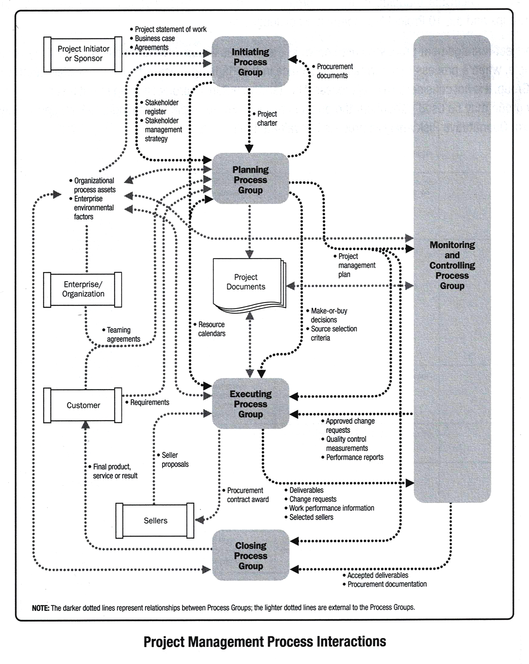
For example, let us take a look at the entire processes involved in the specific case displayed in the diagram below. This is a data-flow diagram describing in detail who the project participants are, what interactions in the project process take place among them, and what project documents are conveyed between each of the project participants.
Dataflow Diagram of Project Process Interactions
The Participant Actors
Project Initiator or Sponsor
Monitoring and Controlling Process Group
Initiating Process Group
Planning Process Group
Executing Process Group
Closing Process Group
Enterprise | Organization
Customers
Sellers
Monitoring and Controlling Process Group
Initiating Process Group
Planning Process Group
Executing Process Group
Closing Process Group
Enterprise | Organization
Customers
Sellers
The Required Documents
Project Statement of Work
Business Case
Agreements
Project Charter
Stakeholder Register
Stakeholder Management Strategy
Requirements
Resource Calendars
Program Management Plan
Seller Proposals
Procurement Contract Award
Procurement Documents
Deliverables
Change Requests
Work Performance Information
Selected Sellers
Approval Change Requests
Quality Control Measurements
Performance Reports
Teaming Agreements
Organizational Process Assets
Business Case
Agreements
Project Charter
Stakeholder Register
Stakeholder Management Strategy
Requirements
Resource Calendars
Program Management Plan
Seller Proposals
Procurement Contract Award
Procurement Documents
Deliverables
Change Requests
Work Performance Information
Selected Sellers
Approval Change Requests
Quality Control Measurements
Performance Reports
Teaming Agreements
Organizational Process Assets
Our Role
Villa Intellia provides for service access to a complete and comprehensive set of project management documents.
- sample documents,
- sample templates,
- sample charts and graphs,
- sample worksheets,
- sample checklists,
- sample forms,
- sample tables,
- sample sets of calculations.
Enterprise Environmental Factors
Agreements
Project Charter
Stakeholder Register
Stakeholder Management Strategy
Requirements
Resource Calendars
Program Management Plan
Seller Proposals
Procurement Contract Award
Procurement Documents
Deliverables
Change Requests
Work Performance Information
Selected Sellers
Approval Change Requests
Quality Control Measurements
Performance Reports
Teaming Agreements
Organizational Process Assets
Enterprise Environmental Factors
Agreements
Project Charter
Stakeholder Register
Stakeholder Management Strategy
Requirements
Resource Calendars
Program Management Plan
Seller Proposals
Procurement Contract Award
Procurement Documents
Deliverables
Change Requests
Work Performance Information
Selected Sellers
Approval Change Requests
Quality Control Measurements
Performance Reports
Teaming Agreements
Organizational Process Assets
Enterprise Environmental Factors
Project Management Documents
|

Project Management Templates
|

Project Management Checklists
|

Essential Project Management Documents
Project Management Templates (available)
Project Management Checklists (available)